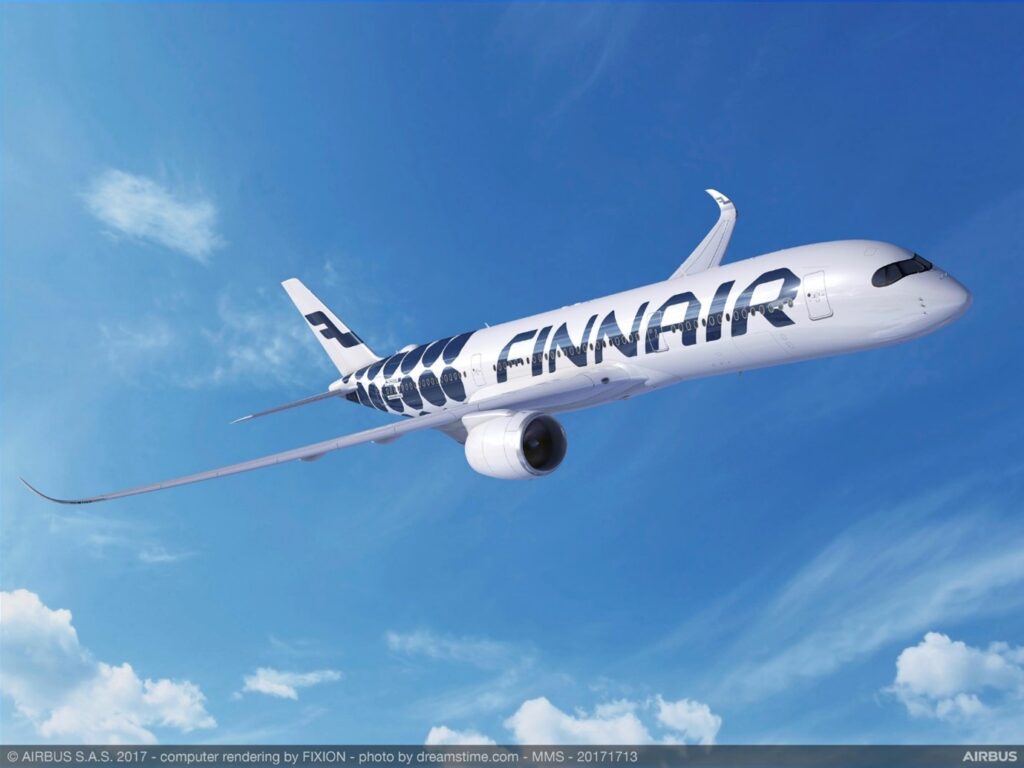
Finnair A350 – Photo: Courtesy Finnair
Finnair is going to the extreme by requiring customers to weigh themselves in addition to their carry-on bags, which most travellers hate to do.
Guests on some flights departing from Helsinki Airport are being asked to weigh themselves with their carry-on bags as part of a voluntary research by Fairline.
The airline plans to utilise the aircraft loading and balance calculation results and hand them over to the Finnish Transport and Communications Agency between July and September.
Two other airlines, Korean Air and Air New Zealand, did comparable research last year.
Satu Munnukka, the head of ground procedures at Finnair, reassured customers that their weight data would not be associated with any personally identifiable information.
“Only the customer service agent working at the measuring point can see the total weight so that you can participate in the study with peace of mind,” Munnukka said.
We take the volunteer customers’ carry-on bags into account while weighing them. During the measuring process, we refrain from collecting personally identifiable information. However, we do record the customer’s age, gender, travel class, total weight (including carry-on luggage), and total weight in our database.
Taxiing, takeoff, and landing weight limits are fixed for each aircraft.
All the people on board, their belongings, and any additional items like food and fuel contribute to this total.
Airlines utilise the standard weights set by each country’s aviation authority to determine the weight of an aircraft, taking into account factors such as the type of aircraft and the number of passengers.
Since 2018, Finnair has utilised average weights determined by its measurements instead of depending on estimates from the European Aviation Safety Authority or Finland’s Civil Aviation Authority.
The airline is now requesting passenger assistance in updating its statistics in order to comply with authorities’ requirements that this information be updated every five years.
There have been cases where airlines, including Scoot, Emirates, United, and Jetstar, have insisted that overweight customers pay for two seats instead of one.
United Airlines says that customers may need to “make additional arrangements” if they are unable to buckle their seatbelts, even with an extender, if their armrests do not remain down while seated, or if they occupy the space of the next seat, according to Jetstar’s website; Jetstar also specifies that passengers must be able to lower both armrests without touching the person next to them.
 Riyadh Air Commences Daily Dubai-Riyadh Flights as Inaugural Flight Takes Flight
  Qantas Project Sunrise A350 Cabin Finalised for Sydney–London
  China Airlines 787 Premium Economy: Style, Space and 4K Tech
  United Unveils New Chef-Curated Menu Items for Polaris Business
  Riyadh Air Opens Tickets to Five New Dreamliner Routes
  Fiji Airways Launches Direct Nadi–Gold Coast Flights
  AmaWaterways Unveils AmaRudi, Europe’s Largest River Ship
  Silversea Wins Big at 2026 Wine Spectator Awards
  Lake Como to St. Moritz: A Luxe Summer Escape for Two
  MSC Cruises Redefines Wellness at Sea With Spa Upgrades