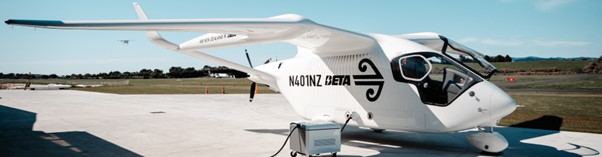
Photo courtesy: Air New Zealand
Manufactured in the United States by global aviation innovator BETA Technologies, the aircraft arrived in New Zealand last week and was blessed at a sunrise ceremony in Tauranga. The ALIA CX300 is expected to fly to Hamilton Airport later today, where it will be based before continuing to Wellington Airport for a further two months in December as part of its demonstration program.
A New Era in Sustainable Aviation
Baden Smith, Air New Zealand’s General Manager – Fleet, Networks and Strategy, hailed the flight as a defining step in the airline’s Next Generation Aircraft Program. The collaboration aims to explore emerging aviation technologies that could transform regional air travel in New Zealand and beyond.
“New Zealand has a proud history of aviation innovation and pushing for progress, from Richard Pearse, who first opened the skies with flying machines, to TEAL flying boats and the engineers who connected us to the world,” said Smith. “It’s incredibly special to partner with a global innovator like BETA to ensure New Zealand is part of shaping what the future of flight might look like. This is a small, cautious step to learn and be part of that change.”
Innovation Meets Pragmatism
Chris Caputo, Director of Flight Operations at BETA Technologies, described the flight as “the intersection of pragmatic design and operational innovation.”
“We built the ALIA CX300 on a foundation of simplicity to ensure a fast, safe, and efficient path to commercial service. With this tech demonstrator collaboration, Air New Zealand is not just validating a single aircraft — they are creating the operational blueprint for regional airlines around the world seeking low-cost, sustainable connectivity.”
About the ALIA CX300
The BETA ALIA CX300 is a battery‑electric, conventional take‑off and landing (CTOL) aircraft built for real‑world performance. Its design leverages existing airport infrastructure, making it easy to integrate into current airport operations without major retrofits. Quiet, efficient, and emission‑free in flight, it represents the next generation of practical green aviation technology.
- Range: Approximately 398 kilometres (215 nautical miles)
- Capacity: Two crew members and 5.6 m³ (200 ft³) of cargo or five passengers
- Propulsion: All‑electric system with zero in‑flight emissions
- Motor: H500A electric engine producing 427 kW (573 hp)
- Noise: Extremely quiet during take‑off and cruise
<
 United x Chef’s Table: World-Renowned Chefs Elevate United Polaris Inflight Dining With Exclusive New Menus
  How the Middle East Conflict Is Reshaping Global Aviation and Pushing Airfares Higher
  Inside Delta’s New Denver Sky Club: A 13,000‑Square‑Foot Rocky Mountain Retreat at DEN
  Qantas Frequent Flyer’s “New Era”: How the Status Shake‑Up Changes Your Flying Life
  From Gulf Hubs to Long Detours: How Today’s Conflicts Are Changing Australia–Europe Travel
  Air Tahiti Nui Launches Non‑Stop Sydney–Tahiti Flights from December 2026
  The Ritz-Carlton Yacht Collection Unveils Ultra-Luxury Winter 2027–2028 Voyages Aboard Evrima, Ilma and Luminara
  Celebrity Cruises Opens 2028 Galapagos Expeditions on Celebrity Flora: Bucket‑List Small‑Ship Adventures Now on Sale
  MSC Cruises Elevates MSC Yacht Club Dining With Elegant New Restaurants Across Fantasia-Class Ships
  Jean-Michel Cousteau Resort Fiji Reopens After Multi‑Million‑Dollar Makeover With New Two‑Bedroom Family Bures