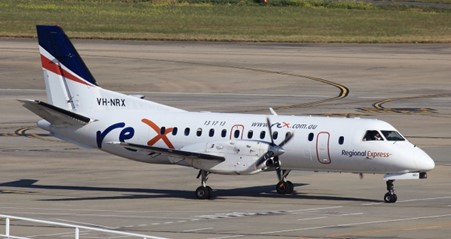
REX Saab 340 - Photo: REX
REX, the largest regional airline in Australia, has confirmed a substantial investment in an aviation startup, opening the door for electric planes to be used by passengers flying between small Australian towns.
Rex has announced that it has acquired a 20% investment in a Sydney startup called Dovetail Electric Aviation.
Having announced a strategic alliance in July of last year, this agreement comes four months after Dovetail received a $3 million federal government grant to finance the research and development of electrically powered aircraft.
Rachael Barritt, manager of business operations at Dovetail, said that the agreement proved the aviation sector was committed to cutting carbon emissions.
She remarked on how encouraging it was to see an Australian airline “put their money where their mouth is” regarding sustainable aviation.
We’re pleased to be working with Rex on such an ambitious project, which she describes as “electric aviation in Australia,” which is a considerable challenge.
Ms Barritt has stated that a flight demonstration will take place within the next year and that the first battery-powered aircraft will be approved within three years.
Ms Barritt raised concern over the cost and availability of sustainable aviation fuel, despite major airlines investing in it to reduce air pollution.
“Sustainable aviation fuels sound great, but there are a lot of issues with them at this point in time,” she added.
Our electric propulsion system has a lifespan of three times that of a conventional combustion engine, and switching to electric will save you 40 percent of current fuel costs.
As part of the agreement, Rex has provided Dovetail with an aircraft to refit, engineering help, and access to testing facilities.
The regional airline uses 61 Saab 340 turboprop planes that might be converted to electric power by Dovetail using MagniX engines.
According to the companies, electric flights might be up to 40% quieter than turbine planes.
In January, Dovetail received $3 million in financing from the government’s Cooperative Research Centres Projects programme. Industry and Science Minister Ed Husic stated that electric aircraft might be a “game-changer” for regional transportation.
However, larger airlines are taking an alternate approach to reducing air travel emissions.
Rex’s commitment comes less than a month after Qantas. Airbus announced a $2 million investment in Queensland’s sustainable aviation fuel plant.
In partnership with the Queensland government, the corporations will fund a feasibility study for a plant that might create 100 mega-litres of biofuel per year using agricultural byproducts such as sugarcane and feedstock.
The refinery’s construction is scheduled to commence in 2024.
Qantas and Virgin Australia have invested in sustainable aviation fuel to achieve an industry-wide objective of net-zero emissions by 2050.
 Jetstar BidCash: How to Upgrade to 787 Business Class From Just $180
  Qantas Tightens Lounge Access for Jetstar Flyers from July 2026: What Frequent Travellers Need to Know
  British Airways Returns to Melbourne: New Daily London–Melbourne Flights via Kuala Lumpur on the 787-9 Dreamliner
  World’s Best Airlines 2026: Qatar, Lufthansa, HK Express and Jetstar Lead AirlineRatings’ Global List
  Australia to Europe: The Most Notable Airline Routes (And How To Book Around the Chaos)
  United x Chef’s Table: World-Renowned Chefs Elevate United Polaris Inflight Dining With Exclusive New Menus
  MSC Poesia Brings Alaska to the Table: New Menus and Dining Venues for 2026 Inaugural Season
  Quiet Luxury Escapes: Wellness-Focused Stays in Costa Rica, Trinidad & Tobago and Hidden-Corner Italy
  Princess Cruises Unveils New ‘North to Alaska’ Experiences for 2026 – Biggest Alaska Season Yet
  Quantum of the Seas Returns to Singapore in 2027–28: Bold Asia Cruises for Every Generation