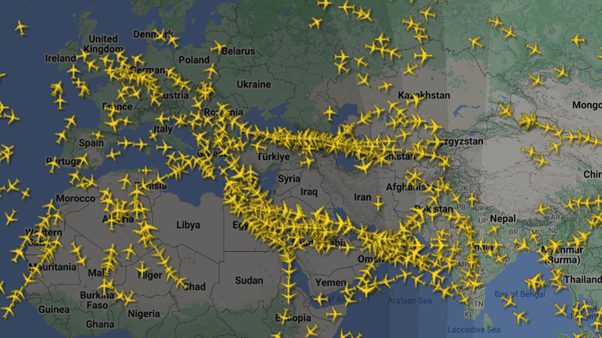
Caption: FlightRadar24
The recent escalation of conflict in the Middle East has led to significant disruptions in major air routes, affecting global aviation. Following a massive missile strike by Iran on Israel, two critical air corridors through the Middle East have been effectively closed, forcing airlines to reroute their flights and causing widespread delays and congestion.
Rerouting and Increased Flight Times
With the closure of airspace over Iraq, airlines are now rerouting their flights over Saudi and Egyptian airspace. This change in flight paths is expected to add between one and two hours to flight times, depending on the destination. The rerouting increases travel time and places additional strain on air traffic control systems as more air corridors become congested.
Airspace Congestion
The impact of these closures is evident on platforms like Flightradar24.com, which shows virtually no aircraft in Iraqi or Syrian airspace. Additionally, the airspace west of Tehran is nearly empty, with only Iran Air flights operating. This congestion will likely persist until there is greater clarity on Israel’s intentions and the overall situation stabilises.
Airline Responses
In response to the crisis, airlines are making adjustments to their routes to ensure passenger safety and minimize disruptions. Qantas, for instance, has advised that its nonstop flights from Perth to London and Perth to Paris will not be significantly impacted. The airline plans to use a route over Saudi Arabia, which will help maintain its schedule with minimal delays.
Broader Implications
The closure of these major air routes highlights the vulnerability of global aviation to geopolitical conflicts. The increased flight times and congestion not only affect airlines’ operational efficiency but also have broader economic implications. Airlines may face higher fuel costs and logistical challenges, while passengers experience longer travel times and potential delays.
Looking Ahead
As the situation in the Middle East remains volatile, airlines and passengers alike must stay informed about potential changes and disruptions. The aviation industry will continue to monitor developments closely and adapt as necessary to ensure safety and maintain service continuity.
How do you think these disruptions will affect your travel plans? Share your thoughts and experiences in the comments below!
 United x Chef’s Table: World-Renowned Chefs Elevate United Polaris Inflight Dining With Exclusive New Menus
  How the Middle East Conflict Is Reshaping Global Aviation and Pushing Airfares Higher
  Inside Delta’s New Denver Sky Club: A 13,000‑Square‑Foot Rocky Mountain Retreat at DEN
  Qantas Frequent Flyer’s “New Era”: How the Status Shake‑Up Changes Your Flying Life
  From Gulf Hubs to Long Detours: How Today’s Conflicts Are Changing Australia–Europe Travel
  Air Tahiti Nui Launches Non‑Stop Sydney–Tahiti Flights from December 2026
  Orient Express Corinthian’s Maiden Voyages Begin May 2026: Ultra-Luxury Mediterranean Sailing Reimagined
  Luxury Mekong River Cruise: Discover Vietnam and Cambodia Aboard Mekong Serenity
  Celebrity River Cruises Redefines Europe’s Rivers With Immersive Storyteller, Skillmaster and Keys to the City Experiences
  Grand Royal Riverside Hue – Fusion Collection: A Wellness-Led Riverside Retreat in Vietnam’s Imperial City